OK, I know it has been a while (in internet time) and apologize. But wait, why should I? It's not like anyone is reading this. Anyway, here are some music videos you will like.
Another Hadag Nachash video this time from their fantastic new album 6. I like that TV gimmick.
This song by The Roots takes an already meaningful song, and creates a moving and powerful reflection on the imperfections of the world. Also, when they performed this song live on Jimmy Fallon (where they are the in-house band), they actually brought along the lead singer of MoF, so take that Eminem.
So now you have seen how a rap song can be truly beautiful, and now...
this...
...
good lord. I think I like this.
Happy Halloween.
Saturday, October 30, 2010


Saturday, October 23, 2010
Good News/Bad News
Good News
As some may know, I am a huge fan of the ex-doujinshi artist group CLAMP's Shoujo masterpiece Cardcaptor Sakura. It has everything that I want to see in a Shoujo series; There was no attempt to hide the girly intentions of the story, giving the series an impressive emotional honesty, yet also did not take itself all that seriously. Pair this with a strong protagonist and downright gorgeous artwork, and we are left with a thoroughly engrossing series. However, Tokyopop's english edition is out-of-print and I literally could not find the fourth volumeof the 12-volume series. Also, the packaging of the T-pop edition is downright ugly, with confusing numbering, iffy image quality, and a garish attempt to downplay the girlyness, that as I mentioned before, is one of the best things about the series. So would you imagine my surprise when I walked into my local comic store this week and lo and behold, DARK HORSE HAS A NEW OMNIBUS EDITION! It is beautiful. I cried. It seems like the publishers really want to take all my moneys this week, because we also have Cross Game!, a series by Mitsuru Adachi, whose popularity in Shonen Sunday rivals The Great Rumiko Takahashi (who you may have noticed I'm a big fan of), yet has had only ONE out-of-print anthology published in english before.
BAD NEWS
School of Seven Bells is my favorite band. SVIIB are Ali Dhezra (lead vocals), Claudia Dhezra (back-up vocals), and Benjamin Curtis (most of the background stuff), and their music has a alluring, mystic sound that has a very unique quality. Well, guess WHAT!?!? Claudia has left the band, and they're now a group of two! (-_-) Sigh...
As some may know, I am a huge fan of the ex-doujinshi artist group CLAMP's Shoujo masterpiece Cardcaptor Sakura. It has everything that I want to see in a Shoujo series; There was no attempt to hide the girly intentions of the story, giving the series an impressive emotional honesty, yet also did not take itself all that seriously. Pair this with a strong protagonist and downright gorgeous artwork, and we are left with a thoroughly engrossing series. However, Tokyopop's english edition is out-of-print and I literally could not find the fourth volumeof the 12-volume series. Also, the packaging of the T-pop edition is downright ugly, with confusing numbering, iffy image quality, and a garish attempt to downplay the girlyness, that as I mentioned before, is one of the best things about the series. So would you imagine my surprise when I walked into my local comic store this week and lo and behold, DARK HORSE HAS A NEW OMNIBUS EDITION! It is beautiful. I cried. It seems like the publishers really want to take all my moneys this week, because we also have Cross Game!, a series by Mitsuru Adachi, whose popularity in Shonen Sunday rivals The Great Rumiko Takahashi (who you may have noticed I'm a big fan of), yet has had only ONE out-of-print anthology published in english before.
BAD NEWS
School of Seven Bells is my favorite band. SVIIB are Ali Dhezra (lead vocals), Claudia Dhezra (back-up vocals), and Benjamin Curtis (most of the background stuff), and their music has a alluring, mystic sound that has a very unique quality. Well, guess WHAT!?!? Claudia has left the band, and they're now a group of two! (-_-) Sigh...
Tuesday, October 19, 2010
Rumiko Takahashi Week (Part Three): Mermaid Saga

"Yuta...live long."
"Dummy, that's the last thing I want to hear."
Mermaid Saga is the story of two outcasts, Yuta and Mana, with a bizarre secret: they cannot die. They have eaten the flesh of a mermaid, which will either grant immortality (Yuta is actually 500 years old), or turn the eater of the flesh into a wretched, brutal monstrosity known as a "Lost Soul". Our heroes wish to live a mortal life, and search for the flesh that is also the one cure for immortality. On the way, they encounter people whose lives are also affected by mermaids in various ways, and try to help.
Despite the recurring main characters, Mermaid Saga is less of a "Saga", than a collection of short stories with a recurring theme- the story has no real ending, nor should there be, yet the conclusion still feels quite final. Without the pressure to tell an ongoing story, Takahashi creates some of her most involving stories ever- and this is the author of Maison Ikkoku! The stories are also somewhat different in tone from what we are used to in Takahashi series. There is no tongue-in-cheek feel to the stories, and in fact, the tone is often horrific. When live mermaids actually show up, which is rarely, do not expect any appearances by Ariel & co.; Mermaids are demons and manipulating femme fatales, as in old sailor lore. The few historical flashbacks, notably a story set in the Edo period in the first volume, are relatively accurate, unlike in Takahashi's most recent series InuYasha, where it might as well be a fantasy world.
Even more impressive than the series itself is the artwork. Mermaid Saga's magazine serialization started smack in the middle of the serialization of Maison Ikkoku, which as I mentioned earlier this week, was the highlight of Takahashi's entire artistic career. The breathtaking visuals look as if they took hours to create, but it cannot be so, for deadlines in the manga profession are famous for really sucking. In another series, the 4-volume length would make this a light, quick read, but every panel made me brood on the story, as well as the skill and craft put into the final product. If ever I meet someone in need of convincing of the power of graphic storytelling, I will point them right over to Mermaid Saga.
Monday, October 18, 2010
Rumiko Takahashi Week (Part Two): Ranma 1/2
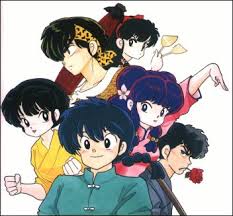
Now here is a series designed designed for mass appeal. Akane Tendo, a tomboyish high-schooler, is one day told by her father, the obsessive martial artist Soun Tendo, that she is to be engaged to Ranma Saotome, who will be the heir to the Tendo "Anything-Goes" School of Martial Arts. However! After a poorly thought-out training mission with his idiot father in China, Ranma has been cursed to turn into a woman when splashed by cold water, of all things.
Despite the what sounds at first like a wet dream (no pun intended) of a plot, the series has a great appeal for a more general audience- in Japan, the series is more popular among young girls than any other demographic. This is because unlike some series that would focus on boobies and fanservice, Ranma 1/2 focuses on bakas and sillyness (actually, there is a constant stream of bare breasts shown in the series, but they are shown in a very un-sexualized manner-- all part of the joke). Takahashi's sense of humor comes from mining the negative aspects of people, so every character gets a chance to be a complete moron, have horrible luck, or most often, both. The series also possesses the amazing range of being silly, really silly, and silly but epic (such as the "Pantyhose Taro" storyline, easily the highlight of the entire series).
The stories don't have that much variation; in his Manga: The Complete Guide, Jason Thompson compares Ranma 1/2 to a long-running sitcom. Towards the end of the series, the artwork attains the glossy, screentoned appearance that is seen in InuYasha and Rin-Ne. I do not particularly like this style as it lacks a certain "homemade" quality that I used to enjoy. However, watching the artwork evolve into the slick modern appearance is actually kinda fun. It should also be added that Takahashi draws a rad Henohenomoheji, and even with flipped artwork it really shines though.
Sunday, October 17, 2010
Rumiko Takahashi Week (Part One): Maison Ikkoku
Last week, I (finally) finished Mermaid Saga and Ranma 1/2, so to celebrate, I have decided to do Takahashi-themed reveiws this week, in which I will discuss these two series, as well as Maison Ikkoku, her best known Seinen series, and also her best series (sorry, InuYasha fans), as well as some other goodies. For those not in the know about Takahashi, go wiki it because I am a reviewer, not a historian, sorry. Today, we will begin with...
Maison Ikkoku By Rumiko Takahashi. Originally published as めぞん一刻 (Mezon Ikkoku). 15 volumes.
"I, Yusaku Godai... am IN LOVE with Kyoko Otonashi!!"


Maison Ikkoku is the story of Godai, a luckless college student (or, well, he's TRYING to get into college) living at the titular run-down apartment. The other, boozier tenants bug him constantly ("Hey, Flunkout!"), but this is the last thing on his mind, for Godai has fallen for the beautiful apartment manager Kyoko Otonashi. However there are many complications. Kyoko is mourning her dead husband, Soichiro. Godai feels/is incompetent. Another man, Mitaka, is vying for Kyoko's affections. Godai has somehow picked up a girlfriend, and does not have the heart to break up with her. The list goes on and on. Can Godai overcome his many obstacles and live a happy life with Kyoko?
OK, opinion time! Rumiko Takahashi has done a lot for the Shonen/Seinen Romantic Comedy genre, from Urusei Yatsura (the first harem manga) to Ranma 1/2 (which introduced gender-bender humor to Shonen), but Maison Ikkoku is very unusual creature, for though it begins as a very over-the-top comedy (and a fantastic one at that), it slowly transitions into a genuine drama, and at around volume 10, the story becomes (nearly) no laughing matter. This may be hyperbole, but when I first read Ikkoku I believed human emotion had never been so fully realized in cartoon form.
Like the story, the art also evolves and matures through the series' 7-year run, from the exaggerated anatomy that defined Takahashi's early works, to a strong, human look that may be the high-point of her entire artistic career. The lack of fanservice is also a nice change of pace.
I recently convinced (well, forced) my dad to read Maison Ikkoku, and is now almost done volume nine. He says he enjoys the silly nature of the series. I look forward to his reaction to volume 10.
OK, opinion time! Rumiko Takahashi has done a lot for the Shonen/Seinen Romantic Comedy genre, from Urusei Yatsura (the first harem manga) to Ranma 1/2 (which introduced gender-bender humor to Shonen), but Maison Ikkoku is very unusual creature, for though it begins as a very over-the-top comedy (and a fantastic one at that), it slowly transitions into a genuine drama, and at around volume 10, the story becomes (nearly) no laughing matter. This may be hyperbole, but when I first read Ikkoku I believed human emotion had never been so fully realized in cartoon form.
Like the story, the art also evolves and matures through the series' 7-year run, from the exaggerated anatomy that defined Takahashi's early works, to a strong, human look that may be the high-point of her entire artistic career. The lack of fanservice is also a nice change of pace.
I recently convinced (well, forced) my dad to read Maison Ikkoku, and is now almost done volume nine. He says he enjoys the silly nature of the series. I look forward to his reaction to volume 10.
Friday, October 15, 2010
Encounter: Geeks According to Nerds
It was a couple of months ago at a certain party at a certain chinese restaurant that I encountered The Geek. The Geek had a worried, fretful expression that seemed to be the only face he ever wore. Suddenly, The Geek looked to me and mumbled, "Do you read Manga?" in a tone normally reserved for questions of sexual orientation. "Yes," I responded, "I read lots of Manga," for I do. The Geek's face suddenly lit up, but not very much as that would distill his fretful expression that had obviously taken years to perfect. He asked me, "Do you read Naruto?"I had to think for a second; should I tell him of how I prefer the original manga over the anime, or how I was kind of getting sick of the endless volumes? How Kakashi is the only character who really holds my interest anymore, and how he now has but a minor role? All I say to him, however is, "Yeah." The Geek's aforementioned fretful demeanor suddenly vanished, replaced by a warm smile, suggesting many joys and sorrows shared only with the boy ninja as he said in a melancholy tone "It's so good." But the somber grin was gone as suddenly as it had came, as he asked me, "Do you watch Death Note?" I did not, but his preference of the series would bring me to read all 12 volumes, and then regret reading all 12 volumes, but I do not know the future, nor am I a Shinigami who might know something about the series, so I, on that day a couple of months ago at a certain party at a certain chinese restaurant with The Geek asking me about Death Note, I said "No." The Geek continued to question me as an interrogator would question a suspect, and now asked me if I was a regular viewer of Family Guy. "No, but I've watched an episode or two before," I exclaimed. The Geek seemed unaware of the "No" part and asked me, "Do you know Stewie?" Of course I did. He then proceeded to mumble out an entire episode of the show (something about Stewie, time travel, and a Chinese guy who says something silly) as if discussing the bible, and remarked, "Isn't that funny..." And then our food was served so The Geek and I began to eat at a certain chinese restaurant at a certain party a few months ago.
It was an encounter.
It was an encounter.
Monday, October 11, 2010
Music Videos That You Will Like 10/12/10
This is not a very original idea for a blog post, and this may not be a regular feature. However, I plan to feature music videos from rather obscure bands, so this will be a fun experiment to see if this sort of thing can work on this blog.
Hadag Nachash (The Fish Snake) are an Israeli hip-hop band, whose political lyrics (thank you, hebrew-speaking friends) and very hip beat have made them a personal favorite, and this vid is inarguably slick. And there are robots! Politics and robots are two of my favorite things in the whole wide world, FYI.
School of Seven Bells (or SVIIB, as the fans like to say) are a really amazing band. With their mystic vibe and layered sound, the Brooklyn group quickly became my favorite band OF ALL TIME. This video is pretty good, and basically sums up everything good (or bad! As I said, niche music) about SVIIB's music.
The South African band (notice a theme here) Freshlyground produced this video with the parody news site ZA News, and watching Zolani party with Zappiro-designed (have fun Wiki-ing) puppet versions of Zuma (and his wives), Mugabe, Mandela, and others is an absolute joy!
Surfer Blood are really rad rock band, who, and I say this having seen them live, are really just some dudes. This video is quite weird (I wonder who thought having the band dressed as Disney characters being mean was a good idea?), but I like weird, and one would be hard pressed to say that it is not inspired.
Happy viewer-ing!
Hadag Nachash (The Fish Snake) are an Israeli hip-hop band, whose political lyrics (thank you, hebrew-speaking friends) and very hip beat have made them a personal favorite, and this vid is inarguably slick. And there are robots! Politics and robots are two of my favorite things in the whole wide world, FYI.
School of Seven Bells (or SVIIB, as the fans like to say) are a really amazing band. With their mystic vibe and layered sound, the Brooklyn group quickly became my favorite band OF ALL TIME. This video is pretty good, and basically sums up everything good (or bad! As I said, niche music) about SVIIB's music.
The South African band (notice a theme here) Freshlyground produced this video with the parody news site ZA News, and watching Zolani party with Zappiro-designed (have fun Wiki-ing) puppet versions of Zuma (and his wives), Mugabe, Mandela, and others is an absolute joy!
Surfer Blood are really rad rock band, who, and I say this having seen them live, are really just some dudes. This video is quite weird (I wonder who thought having the band dressed as Disney characters being mean was a good idea?), but I like weird, and one would be hard pressed to say that it is not inspired.
Happy viewer-ing!
Subscribe to:
Posts (Atom)