Showing posts with label takahashi. Show all posts

Monday, April 25, 2011

April MMF: Maison Ikkoku, and the Emotional Core of a Wacky Comedy

SPOILER WARNING! I am writing this under the assumption that most reading have read Maison Ikkoku, so if you have not, you have been warned...

 Ah, the Manga Movable Feast, the only time anyone reads my blog, and sees my own self-deprication. In some ways, I really shouldn't write for this thing, as if I happen to write in a sloppy fashion, my lack of editing will be on display to the whole blog-o-sphere. And yet, I feel an obligation to write this time 'round. This month's MMF is about Rumiko Takahashi. When I started this blog, I wrote three reviews of Takahashi books in a row for what I billed "Rumiko Takahashi Week." When I wrote these, I was not as good at thinking critically as I am now, and looking back on them, I see my writing as a hilariously pretentious, hyperbolic, garbled mess (Ikkoku: human emotion had never been so fully realized in cartoon form!) with criminal overuse of the words "fan" and "best". I feel bad about mistreating the wonderfully zany Rumic World, and this is my attempt to redeem myself, if just a little.

Maison Ikkoku is a comedy. There is no denying that. Rumiko Takahashi writes comedies. Maybe there are some soapy elements to the story of Yusaku Godai's attempts at wooing the beautiful apartment manager Kyoko, but it is first and foremost a comedy. And yet when I first read the series, I took it seriously, too seriously in fact. What it was that made me so invested in a character like Yusaku, who I was originally supposed to pity and/or laugh at? What made Maison Ikkoku so important to me, and to readers in general?

One thing that elevates Maison Ikkoku (which will henceforth by refered to simply as Ikkoku) above the well-meaning fun that comprises her overall catalog is the characters. Takahashi's natural knack for characterization has always been one of her strong points, and in Ikkoku the characters are not only well-defined and interesting, but well-rounded to boot! Not every character is of course, but that's fine. If we saw any other side of Mr. Yotsuya's lecherous lifestyle, would he be as funny? This notwithstanding, many of Ikkoku's major characters are remarkably well fleshed out. For example, Shun Mitaka, Yusaku's rival with a fear of dogs, is initially treated as the "bad" guy whose fear of dogs only serves as a way to give Yusaku a way to "win", but as the series progresses, we realize that he is a far nicer guy than we thought, and deserving of Kyoko's (and the reader's) sympathies. He even got the happy ending he deserved, overcoming his fear of dogs and happily married to a beautiful woman with countless puppies for pets. However, many series have great characters; For example, Naruto. And the heavy emotion resonance the series possesses can't come from the story, which cartwheels from slapstick to sitcom to soap (oh god, THE SOAP!). Did I react like this to Friends? No, because a live-action TV show lacks one thing that a comic book can have, as this one does...

What I allude to here is artwork and panel orientation. Takahashi's artwork has had some serious ups and downs over the course of her career, from its lovable but messy origins to the polished but over screen-toned look of Inuyasha and Rinne, but the artwork in Ikkoku is Takahashi at her strongest. While beginning with that early Takahashi vibe in both story and artwork, the art matures to a certain "hand-drawn" quality. The above two cover images serve as a good example of this. Through these covers, we are shown Kyoko through Yusaku's eyes, a naturally beautiful woman worth the world. This skill is shown in the interior art as well. Chapter 47: The Kissing Scene (in Vol. 5, BTW) is an emotional roller coaster, beginning with a clearly humorous scene where Akemi, drunk, kisses both Yusaku and Kyoko, and moves toward its conclusion, one of my favorite manga sequences of all time, in which only the characters' mouths can be seen.
Maison Ikkoku Manga (v.5, ch.4, p.29)
[Click to view next page or press next or back buttons]
And yet, the emotional gravity of Ikkoku does not come from the artwork, but from what has been called Rumiko Takahashi's greatest failure as a cartoonist. Readers of any of Takahashi's series should know by now that Takahashi does not plan her stories in advance at all beyond the premise. In other Rumik series such as Inuyasha and Ranma 1/2, this caused (for Inu) pacing issues and (for Ranma) lame conclusions. But Ikkoku did not suffer from this, but rather benefited immensely. Without the constraint of "knowing" where the story would go, Takahashi is free to change the direction of the plot and mess with reader's expectations with ease. Like the characters in the story, the author rarely seems fully aware of what will happen next, and because of this, neither does the reader. Unlike many romantic comedies (including Ikkoku, in its anime version), the core romance's success is not set in stone, and there are times when it looks like Yusaku will move on, or Kyoko will reject him, and that would just be life. Kozue is a nice girl anyway, and Yusaku could always end up with her. Of course, he does end up with Kyoko, but by that point, it feels like a genuine victory rather than an inevitable Finale.

Of course, lack of planning can't always be a good thing. For one thing, there's Nozomu, a brief "Mary Sue”, and comedic foil to Mr. Yotsuya, who proceeds to become even less than a Mary Sue, but a complete non-character. And then there is the unfortunate case of Kozue Nanao. Kozue is a bit of a Mary Sue herself, who through sheer niceness, becomes Yusaku’s girlfriend, in a relationship that Yusaku wants to end but can never bring himself too. Like Knives in Scott Pilgrim, a series influenced by Takahashi, Kozue is just too nice for her own good as Yusaku has no feelings for her and cannot end their relationship. However, when the end of the series comes, this is never dealt with. Instead Kozue is proposed to by a man who is unseen in the series. In the final chapter there is a page even showing Kozue saying that she is happy with mystery man, her hubby. It would seem thus that on the subject of Kozue, Yusaku and Takahashi are of the same mind. What do you mean, one might ask. No, that’s too pretentious. What’s the dope yo? you might ask. What the dope is..no not what the dope is. I’ll be pretentious. What I mean is that both seem to think that Kozue is too kindly to hurt. However, by doing this we loose any character development that could have evolved and simply get a “Mary Sue.”

Once again, I must repeat that Maison Ikkoku is a comedy, but not a comedy like Ranma 1/2. Through the lens of humor and drama, we are shown a real world populated by real people with real emotions. Don't take it too seriously, but do keep in mind that Ikkoku is more than just a comedy: it's a smart comedy.

Tuesday, October 19, 2010

Rumiko Takahashi Week (Part Three): Mermaid Saga

Mermaid Saga By Rumiko Takahashi. Originally published as 人魚シリーズ (Ningyo Series). 4 volumes.
"Yuta...live long."
"Dummy, that's the last thing I want to hear."


 Mermaid Saga is the story of two outcasts, Yuta and Mana, with a bizarre secret: they cannot die. They have eaten the flesh of a mermaid, which will either grant immortality (Yuta is actually 500 years old), or turn the eater of the flesh into a wretched, brutal monstrosity known as a "Lost Soul". Our heroes wish to live a mortal life, and search for the flesh that is also the one cure for immortality. On the way, they encounter people whose lives are also affected by mermaids in various ways, and try to help.


 Despite the recurring main characters, Mermaid Saga is less of a "Saga", than a collection of short stories with a recurring theme- the story has no real ending, nor should there be, yet the conclusion still feels quite final. Without the pressure to tell an ongoing story, Takahashi creates some of her most involving stories ever- and this is the author of Maison Ikkoku! The stories are also somewhat different in tone from what we are used to in Takahashi series. There is no tongue-in-cheek feel to the stories, and in fact, the tone is often horrific. When live mermaids actually show up, which is rarely, do not expect any appearances by Ariel & co.; Mermaids are demons and manipulating femme fatales, as in old sailor lore. The few historical flashbacks, notably a story set in the Edo period in the first volume, are relatively accurate, unlike in Takahashi's most recent series InuYasha, where it might as well be a fantasy world. 


Even more impressive than the series itself is the artwork. Mermaid Saga's magazine serialization started smack in the middle of the serialization of Maison Ikkoku, which as I mentioned earlier this week, was the highlight of Takahashi's entire artistic career. The breathtaking visuals look as if they took hours to create, but it cannot be so, for deadlines in the manga profession are famous for really sucking. In another series, the 4-volume length would make this a light, quick read, but every panel made me brood on the story, as well as the skill and craft put into the final product. If ever I meet someone in need of convincing of the power of graphic storytelling, I will point them right over to Mermaid Saga.

Monday, October 18, 2010

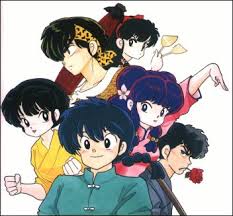
Rumiko Takahashi Week (Part Two): Ranma 1/2

Ranma 1/2 By Rumiko Takehashi. Originally published as らんま½ (Ranma Nibun-no-Ichi). 36 volumes.
Now here is a series designed designed for mass appeal. Akane Tendo, a tomboyish high-schooler, is one day told by her father, the obsessive martial artist Soun Tendo, that she is to be engaged to Ranma Saotome, who will be the heir to the Tendo "Anything-Goes" School of Martial Arts. However! After a poorly thought-out training mission with his idiot father in China, Ranma has been cursed to turn into a woman when splashed by cold water, of all things.

 Despite the what sounds at first like a wet dream (no pun intended) of a plot, the series has a great appeal for  a more general audience- in Japan, the series is more popular among young girls than any other demographic. This is because unlike some series that would focus on boobies and fanservice, Ranma 1/2 focuses on bakas and sillyness (actually, there is a constant stream of bare breasts shown in the series, but they are shown in a very un-sexualized manner-- all part of the joke). Takahashi's sense of humor comes from mining the negative aspects of people, so every character gets a chance to be a complete moron, have horrible luck, or most often, both. The series also possesses the amazing range of being silly, really silly, and silly but epic (such as the "Pantyhose Taro" storyline, easily the highlight of the entire series).

 The stories don't have that much variation; in his Manga: The Complete Guide, Jason Thompson compares Ranma 1/2 to a long-running sitcom. Towards the end of the series, the artwork attains the glossy, screentoned appearance that is seen in InuYasha and Rin-Ne. I do not particularly like this style as it lacks a certain "homemade" quality that I used to enjoy. However, watching the artwork evolve into the slick modern appearance is actually kinda fun. It should also be added that Takahashi draws a rad Henohenomoheji, and even with flipped artwork it really shines though.

Sunday, October 17, 2010

Rumiko Takahashi Week (Part One): Maison Ikkoku

Last week, I (finally) finished Mermaid Saga and Ranma 1/2, so to celebrate, I have decided to do Takahashi-themed reveiws this week, in which I will discuss these two series,  as well as Maison Ikkoku, her best known Seinen series, and also her best series (sorry, InuYasha fans), as well as some other goodies. For those not in the know about Takahashi, go wiki it because I am a reviewer, not a historian, sorry. Today, we will begin with...

Maison Ikkoku By Rumiko Takahashi. Originally published as めぞん一刻 (Mezon Ikkoku). 15 volumes.
"I, Yusaku Godai... am IN LOVE with Kyoko Otonashi!!"
Maison Ikkoku is the story of Godai, a luckless college student (or, well, he's TRYING to get into college) living at the titular run-down apartment. The other, boozier tenants bug him constantly ("Hey, Flunkout!"), but this is the last thing on his mind, for Godai has fallen for the beautiful apartment manager Kyoko Otonashi. However there are many complications. Kyoko is mourning her dead husband, Soichiro. Godai feels/is incompetent. Another man, Mitaka, is vying for Kyoko's affections. Godai has somehow picked up a girlfriend, and does not have the heart to break up with her. The list goes on and on. Can Godai overcome his many obstacles and live a happy life with Kyoko?

OK, opinion time! Rumiko Takahashi has done a lot for the Shonen/Seinen Romantic Comedy genre, from Urusei Yatsura (the first harem manga) to Ranma 1/2 (which introduced gender-bender humor to Shonen), but Maison Ikkoku is very unusual creature, for though it begins as a very over-the-top comedy (and a fantastic one at that), it slowly transitions into a genuine drama, and at around volume 10, the story becomes (nearly) no laughing matter. This may be hyperbole, but when I first read Ikkoku I believed human emotion had never been so fully realized in cartoon form.

 Like the story, the art also evolves and matures through the series' 7-year run, from the exaggerated anatomy that defined Takahashi's early works, to a strong, human look that may be the high-point of her entire artistic career. The lack of fanservice is also a nice change of pace.

 I recently convinced (well, forced) my dad to read Maison Ikkoku, and is now almost done volume nine. He says he enjoys the silly nature of the series. I look forward to his reaction to volume 10.