5: Emma by Kaoru Mori (10 volumes)
Set in Victorian London, Emma is the story of a forbidden romance between William Jones, a young man from a wealthy family, and Emma, a maid. Though the British setting is meticulously researched, Emma is undoubtably still a very Japanese comic; the style and pacing rush with life in a manner hard to find in most contemporary western cartooning. The main story is 7 volumes long, with 3 volumes of side stories.

4: House of Five Leaves by Natsume Ono (3 volumes, ongoing [8 in Japan] )
In my last post of this kind, I mentioned Lone Wolf and Cub, a period drama set in feudal Japan. House of Five Leaves is also a period drama, but unlike Lone Wolf, is not a pulpy masterpiece, but an emotional one. Akitsu, a traveling ronin whose shy nature prevents him from being good at his job, becomes entangled in the criminal organization "Five Leaves" after working as a bodyguard for Yaichi, the mysterious leader of the Five Leaves. Like Lone Wolf, the true strength of the series is not in the (well written) story, but in the artwork; Ono's style is very different from Kojima's, but also elegantly captures the mood of its historical setting with a unique style that is clearly Japanese without being "manga-style".
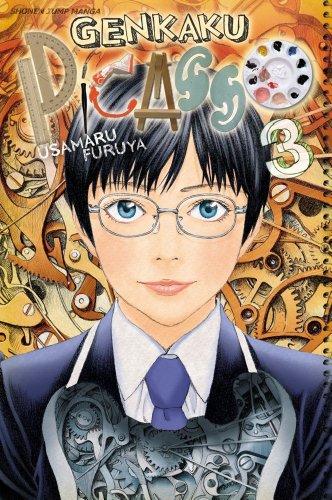
3: Genkaku Picasso by Usamaru Furuya (3 volumes)
For current North American audiences there are basically two sides to what we call "manga": manga of the popular, Naruto-ized variety, and edgy contemporary works labeled gekiga in big letters. For this reason, new readers may want to check out Genkaku Picasso, a JUMP manga created by an artist who got his start in Garo. The story follows Hikari "Picasso" Hamura, a neurotic teenage artist who dives into his own surrealist artwork with the aid of his dead friend Chiaki (reincarnated as a tiny person with angel wings) to help the people the drawings are based on. The insanity of Furuya's art is dialed down a bit (just a bit) for his JUMP debut, but the emotional focus is stronger than ever, as the characters clearly have strong emotional connections to the author. At a recent event at the Toronto Comic Art Festival, Furuya had only one thing to say about his creation: "I am Picasso!"

2: Paradise Kiss by Ai Yazawa (5 Volumes)
Smart, sexy, and genuinely stylish, Paradise Kiss is the story of a young woman who risks everything for a dream. The young woman in question is Yukino "Caroline" Hayasaka, a high school senior who abandons her mom's plans for her future after a chance encounter with Paradise Kiss, a small fashion label run by a group of art-school eccentrics. Yukino becomes good friends with the people of ParaKiss, and maybe a bit more than friends with the bisexual designer George, and begins to pursue a new career in modeling. Along with very strong writing (for once, the couples are allowed to have *realistic* sex before the last volume), Ai Yazawa is a very good artist. The artwork is crisp and pleasantly gothic, and, as you would expect in a comic first published in a fasion magazine, all the characters are immaculately dressed. Highly recommended for those who like their romance stories with some class.

1: Honey and Clover by Chica Umino (10 volumes)
Like Paradise Kiss, Honey and Clover is a Josei manga about art school students, but the similarities end there. Honey and Clover is a delightful rom-com about two love triangles, a circle of friends, and a dash of mono no aware. Takemoto is a directionless art school student who live in a boarding house (like Maison Ikkoku!) with fellow students Mayama and Morita. When they are introduced to Hagumi, the second cousin of their professor, Takemoto and Morita both immediately fall in love with her, though they have difficulty expressing it. This is only one of the love triangles in this sweet story about colledge years. And sweet it is - it's hard to read a volume of Honey and Clover without having a big smile on your face by the end. The early volumes have a slightly off-kilter pace, but as the series goes on both the reader and the author form a strong attachment to the characters, and both every-day moments and major events are treated with caring grace. Honey and Clover is not the best comic in the world, but portrays the joys and woes of youth beautifully.